Is there a history app for cycling? What exists in 2026
In short: yes, but only a few, and most of them are outdoor audio tours that play stories as you pass real places. On an indoor bike your choices are a podcast or audiobook, a video app that films real roads, or a history app built for the trainer, such as Cyclorama, where the distance you pedal moves an era of history forward and dated moments appear as you reach them.
What riders mean by "history while you ride"
Most answers you will find to this question point to outdoor apps: route planners, ride trackers and GPS audio tours. Those are good if you ride outside. A tour such as VoiceMap's 16 km Denver cycling tour plays stories about the city's past at each stop, and VoiceMap says its app uses GPS to play audio "at the right time and place".
Indoors, the bike does not go anywhere, so a GPS tour has nothing to trigger it. Most people asking from a trainer are after something else: a reason to keep pedalling that is not another show. One rider put it as "getting a bit bored of cycling in increasingly realistic indoor worlds" (r/IndoorCycling). Another said: "I usually cycle and watch a variety of content on my TV/monitors, listen to music, or read novels on my phone" (r/cycling).
So here are the three ways to get history onto an indoor ride, from no app at all to a history app made for the trainer, with what each does well.
Option 1: podcasts and audiobooks on the trainer
The simplest answer, and the one many riders already use. Put on a history podcast or an audiobook, set an easy pace and ride. It costs little or nothing, works with any bike and any phone, and there is no shortage of good history to listen to.
The limit is that the story has nothing to do with the ride. It plays on whether you pedal or stop, and an hour on the bike is an hour of audio, not a stretch of a journey. If you only want company for a steady ride, that is fine, and you don't need an app.
Option 2: video routes through real places
Several indoor apps play filmed video of real roads, from famous climbs to holiday islands. Rouvy offers real routes from around the world with real gradients. FulGaz lists more than 2,000 real-world rides from over 60 countries ("Less Virtual. More Reality."). Kinomap has thousands of video routes for exercise bikes, treadmills and rowers. Zwift's new top tier, Zwift+, adds Zwift Video, with 21 filmed real-world routes in six countries at launch, including the Col du Galibier and Sa Calobra. Rouvy, Kinomap and FulGaz compared sets out their prices and what you see on screen.
These are the best choice if you want to see a place. Their own pages talk about roads, gradients and destinations rather than history, so you see where you are but not what happened there. Most also need a subscription after the trial, so check each app's own site for today's price.
Option 3: a history app built for the trainer
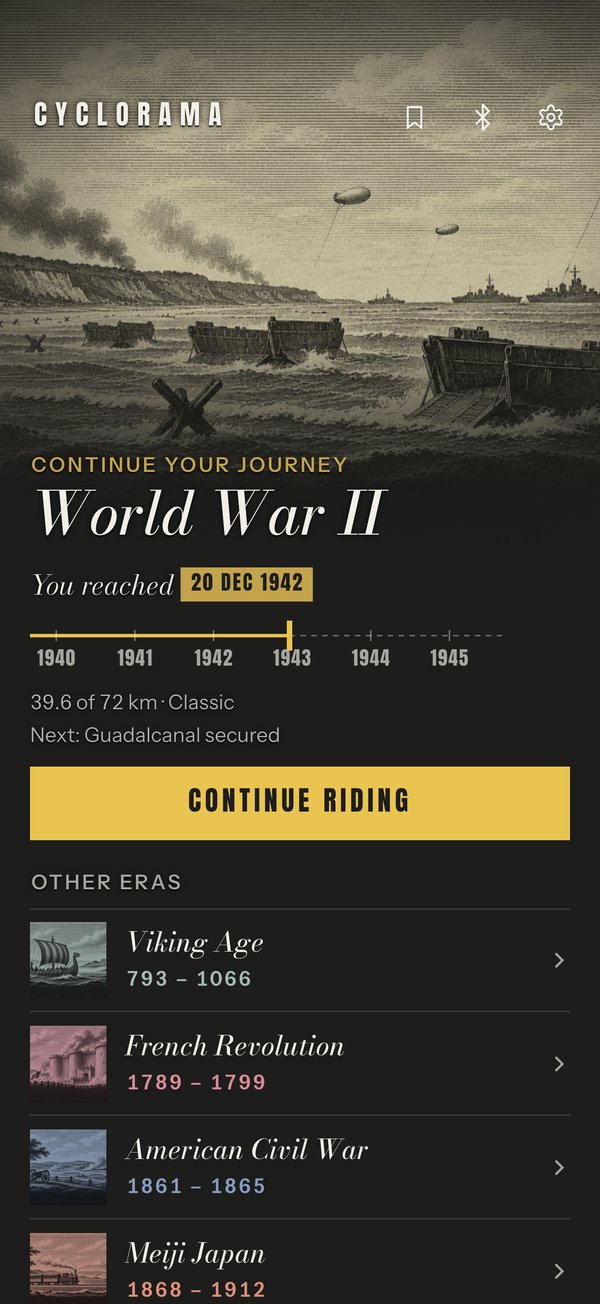
Cyclorama is an indoor cycling app for iPhone and iPad built on dated moments. You pick an era and pedal. Every kilometre moves the era's calendar forward, and its moments appear as you reach them. In version 1.1.0 the ride screen shows "the date, your speed and one story card over a map of where it happened" (App Store release notes). It has no account, and riding works offline: see indoor cycling apps with no account.
- The ride is the story. Each era runs from its first day to its last. Your place is kept between rides, so a long era becomes a few weeks of sessions.
- Two lengths. A Sprint of about 25 km with the key events, or a Classic route of 55 to 89 km with the full story. Each keeps its own progress. See routes.
- Read or listen. Cards can be read aloud with your device's own voice, offline. Narration is off until you switch it on. See narration.
- A bike, with or without a sensor. Smart trainers, power meters, Bluetooth speed or cadence sensors, or no sensor at all. Riding without a smart trainer.
- No account, no ads. Your rides stay on your phone.
It is not a training app. It never changes your trainer's resistance, and it has no structured workouts, group rides or races. Use it for easy and endurance rides, and keep a training app for intervals. The apps compared page sets it beside Zwift, MyWhoosh, Rouvy, FulGaz and Kinomap. If you are leaving Zwift, Zwift alternatives and what each app is for sorts the apps by job.
The six eras at a glance
| Era | Years | Classic route | Moments |
|---|---|---|---|
| World War II | 1939 to 1945 | 72 km | 495 |
| World War I | 1914 to 1919 | 60 km | 499 |
| American Civil War | 1861 to 1865 | 56 km | 500 |
| French Revolution | 1789 to 1799 | 63 km | 500 |
| Meiji Japan | 1868 to 1912 | 89 km | 488 |
| Viking Age | 793 to 1066 | 55 km | 500 |
That is 2,982 moments in all. The calendar moves at different speeds: about a month per kilometre in the two world wars and the Civil War, two months in the French Revolution, six months in Meiji Japan and about five years in the Viking Age. For the longest stretch of time, read the Viking Age timeline, 793 to 1066. Some eras describe war and mass violence, and their start pages say so before you ride. The full list is on the eras page.
What it is not
Cyclorama is not a history learning app or a course. The history text is adapted from Wikipedia under CC BY-SA 4.0, and every moment links to its source article, so you can read further when a card catches you. It may contain mistakes, simplifications or uncertain dates and is not a substitute for scholarly sources. Think of it as a way to follow an era on the bike, with the sources a tap away.
Questions
Are there cycling apps that teach you history while you ride?
A few, and most are outdoor audio tours, such as VoiceMap, that play stories about places as you ride past them. For an indoor bike, Cyclorama moves an era of history forward with the distance you pedal and shows dated moments as you reach them. It is not a course: its history text is adapted from Wikipedia and may simplify.
Can I listen to history podcasts or audiobooks on an indoor bike?
Yes. Any podcast or audiobook app works alongside a trainer, and it works well for steady rides. It does not tie the story to your effort, so the episode carries on whether you pedal or not.
Do I need a smart trainer to ride through history in Cyclorama?
No. Cyclorama reads smart trainers, power meters and Bluetooth speed or cadence sensors, and it also works with no sensor: you set your speed with a slider and the ride uses estimated distance.
Is Cyclorama free?
It is a free download on the App Store with no subscription. Sprint routes are free for good.
Get Cyclorama
Cyclorama is free on the App Store for iPhone and iPad. Android is coming soon: join the beta and we'll invite you.
Download on the App Store Android beta
Image credits
| Credit | Licence | Source |
|---|---|---|
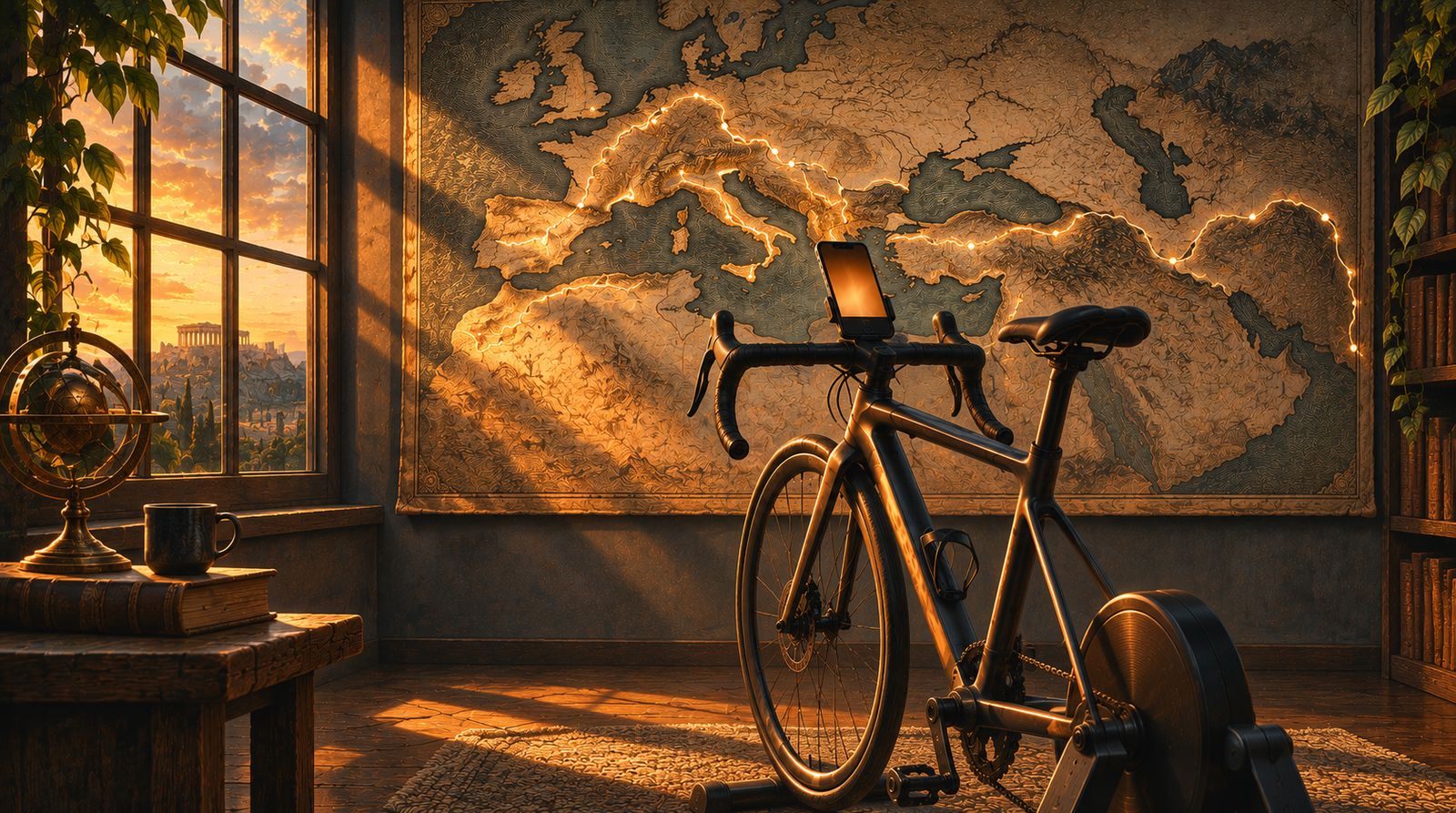
| Illustration, not a photograph: an indoor bike facing a large antique map with glowing routes across it, a phone on the handlebars. Created for Cyclorama with ChatGPT (AI-generated) | AI-generated by us (ChatGPT) | |
| J. H. Colton (file supplied to Commons by Geographicus Rare Antique Maps) | Public domain | source |
| Cyclorama on iPhone. App Store screenshot, Cyclorama | Own product screenshot, from the App Store listing | source |
